
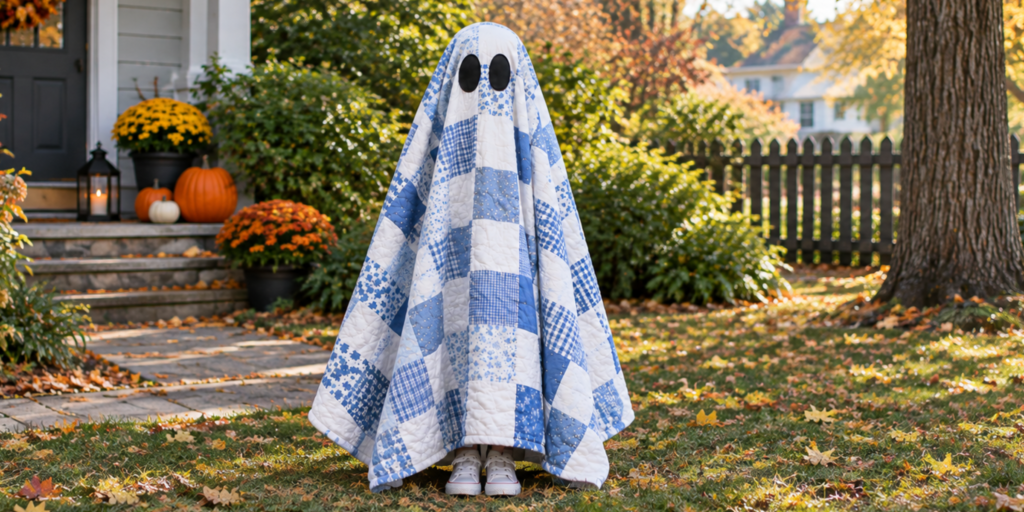
The Little Ghost Who Was a Quilt:
A variation on Pass the Pumpkin for Halloween
Lesson by Katie Jones; Book by Reil Nason
Click here to download a pdf of Katie’s lesson
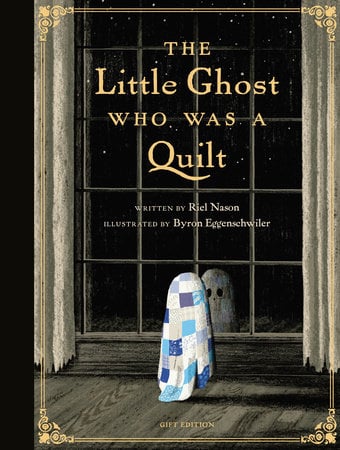
Ghosts are supposed to be sheets, light as air, and able to whirl and twirl and float and soar. But the little ghost who is a quilt can’t whirl or twirl at all, leaving him feeling sad and left out. Students love combining the melody of “Pass the Pumpkin” with the game play of “Bluebird Through My Window.” Enjoy playing along with this sweet tale of Halloween bravery and kindness.
Objective:
Develop empathy while engaging with a singing & playing game.
Lesson:
Start by reading the book jacket only as a preview of the story to come. Teach the song and game before reading the full story in order to increase student engagement as the game is played every 2-3 pages of the story.
Book Jacket:
Ghosts are supposed to be sheets, light as air and able to whirl and twirl and float and soar. But the little ghost who is a quilt can’t whirl or twirl at all, and when he flies, he gets very hot.
He doesn’t know why he’s a quilt. His parents are both sheets, and so are all of his friends. (His great-grandmother was a lace curtain, but that doesn’t really help cheer him up.) He feels sad and left out when his friends are zooming around and he can’t keep up.
But one Halloween, everything changes. The little ghost who was a quilt has an experience that no other ghost could have, an experience that only happens because he’s a quilt . . . and he realizes that it’s OK to be different.
Song:
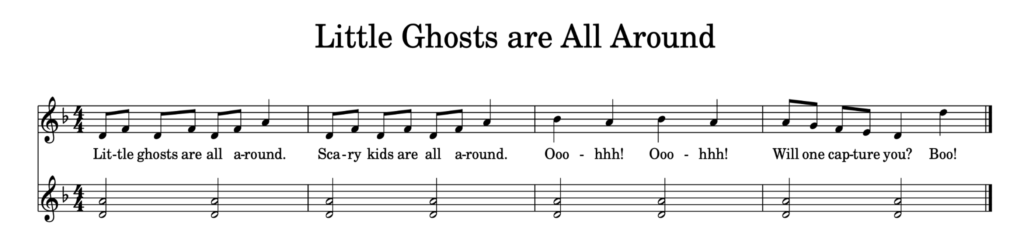
Game Directions:
- Everyone makes a standing circle. One student holding a scarf or small blanket is the ghost.
- The ghost weaves in and out of the circle (like “Bluebird Through My Window”)
- If the ghost is on the inside of the circle on “boo!”, they are captured and choose a new ghost. If the ghost is on the outside they get 1 more turn, then choose a new ghost.
- Integrate game play periodically through the story.
Teacher Talk: Strategies that worked for me!
- Teach the song for singing only first. For younger students, this may be the total experience before engaging in the game and book.
- Wait to add the book after kids are familiar with the game and instrument parts.
- Compare movement with scarves and a small quilt or blanket; can the scarves move faster & lighter than the heavier quilt? Could this be an opportunity to explore weight for movement in a tangible way? If you don’t have a quilt, any heavier blanket will do nicely.
- If you’re going to add the instrument component to the game, give students the option to switch roles 2-3 times throughout the book. I like to phrase this as “If you like where you are, stay there! If you want to switch, do that now!” This strategy has helped me bring a much greater enjoyment of this activity to my students because they have ownership.
- For younger students or shorter class time you may wish to keep this as a singing game only, otherwise I like to teach the whole class the instrument portion of the game before initiating game play. Once game play has started students can select either steady beat ostinato or melody more easily. A happy accident on this song that helped me is that the boomwhacker pitches for D-F-A are popular Halloween colors (purple/lime green/orange) which helped my students quite a bit. I also gave my students the choice to play the steady beat on the bass xylophones or tubano drums. I do not have students play the “Oooh” part since it provides a good opportunity to play with dynamics as we sing.









One Response
I love this! Great use of a favorite game and favorite tune! The book also sounds super cute. Thanks for sharing!