by Hannah Lemont
American Thanksgiving can be such a lovely time to reflect on what we are grateful for, but also a tricky holiday to include in the elementary music room. Between the problematic historical telling of the first Thanksgiving and the lack of high quality Thanksgiving songs that are singable for children, some years I have hardly acknowledged the holiday in my classroom, besides maybe some food-themed rhythmic building block words!
Last year, as I sat at the AOSA conference closing ceremonies and reflected on what I wanted to teach my 3rd-5th grade students the next week, I knew that my community needed a gratefulness theme.
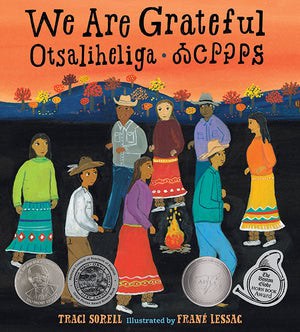
I started with the book We are Grateful: Otsaliheliga by Traci Sorell and Frané Lessac- the book walks us through the seasons from the eyes of a Cherokee tribe member, reflecting on celebrations and typical experiences throughout the year. With beautiful illustrations and a pronunciation guide, it’s a wonderfully accessible way for teachers to learn with students. Because I wasn’t confident that I would remember how to correctly say Otsaliheliga (oh-jah-LEE-hay-lee-gah) on the subsequent pages after the pronunciation was included, I made sure to write myself a note and stick it on the back of the book to refer to when I was reading it aloud to my students.
While reading the story, sing the lyrics to the following song with body percussion after each season, inspired by MFC Volume 2 #2.6:
“We are Thankful for the Earth
The Seasons change and so do we
It’s just as it should be
We are Thankful for the Earth”
After reading the book to your students, ask them to do the body percussion with you while you sing. Then, challenge them to do the body percussion on their own while you sing, and vice versa. When they’re ready, split them in half, asking each group to either sing or do the body percussion. Finally, have your students put it all together and do both jobs at the same time. I tell my students that this is a great time for them to differentiate for themselves! If doing both is too hard for them right now, just choosing one for now is a great choice.
After the kids are solid on the song, it’s time to brainstorm a list of things they are grateful for! After getting a decent list of things the kids are grateful for, you could also ask them what they think other people in their lives (their grown-ups at home, their teachers, their friends, etc) might be grateful for. I tried this on a whim and was pleasantly surprised at the variety of answers I got; I was not expecting the kids to have MORE ideas for others than they did for themselves.
This is where the lesson could go down any pathway you want! Reflect on what skills or concepts your kids need to practice right now. Need to practice a certain rhythm? Figure out what rhythms correspond with different list items they’re thankful for, and have the students create a 4-16 beat B section to the song. Want to work on creative movement? Ask students to pick 1-3 things they’re thankful for and create a movement sentence that goes with them. Want to explore dramatic play? Have the students act out a scene of what they’re grateful for and have the rest of the kids guess what it is. Want to start having kids create their own ostinati? Use the thankfulness list as a starting point for words to use for a spoken/body percussion ostinato to put under the song. This is what my students and I did; our results included: “I love all of my cats!” Ice cream, cake, and pumpkin pie!” “Taylor Swift, Taylor Swift, Taylor Swift, and video games!”
With any of these pathways, you’ll need to make a plan for how you’ll demonstrate the creation process as a whole class, how you’ll split into groups to work, and how you’ll handle groups who are done long before everyone else. You’ll also want to consider how you’ll want to share out their work (Rondo time, anyone?), how they’ll be able to reflect on their work, and how they’ll be able to come back to their work if this process is split over more than one class period.
While planning for all of those things might feel overwhelming, if you are able to find a system that works for your community and use it consistently, all of those steps will quickly become second nature for both you and your students, no matter what kind of creative project you’re working on. Need someone to help brainstorm how to solve particular challenges in those classroom procedures for your community? Shoot me an email- I’d be happy to listen and try to come up with some solutions.
Finding a pathway to explore gratefulness without ending up in a land of toxic positivity felt difficult to me for many years- my hope is that these ideas can help inspire you and your students to authentically reflect on the delights in your life, finding light, no matter how dark it may sometimes feel.