

Objective for K-2:
Students will be able to perform an Orff orchestration.
Extensions: Xylophone Exploration, Rhythmic Building Blocks, Movement (monster shapes, monster faces, move like a monster etc.)
Lesson:
This lesson can be used anytime during the year. Since it is a monster story – not a Halloween story – it works for all seasons! I based this lesson off of a wonderful book called I Just Ate My Friend! by Heidi McKinnon.
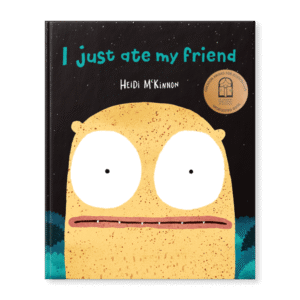
The book begins with a monster who – surprise! – ate their ONLY friend. The monster is so heartbroken and goes on a journey to find a friend. The monster meets all different kinds of monsters, will he find another friend? I highly encourage you to purchase the book! The pictures are very expressive, and it’s a very fun story!
Links:
Step 1:
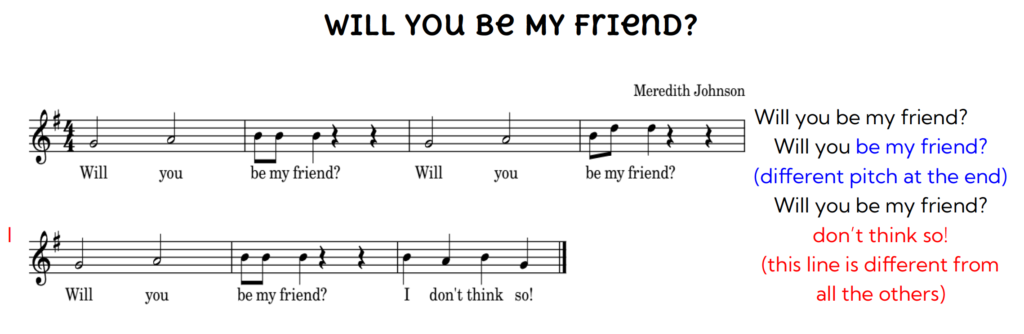
I begin by telling my students that I have this friend who is having trouble finding friends! Do you think we can help them? I’m not sure why they are having so much trouble. I ask students why they think that is happening and we talk about it for a little bit. Then I begin singing the song. The students will more than likely begin singing along with you right away! I don’t try to stop it, however after singing the song, I do make note of how the melody changes on the second line (see at the bottom of the page). We take some time to practice the change, and the last line of the melody which is completely different from all the others.
Step 2:
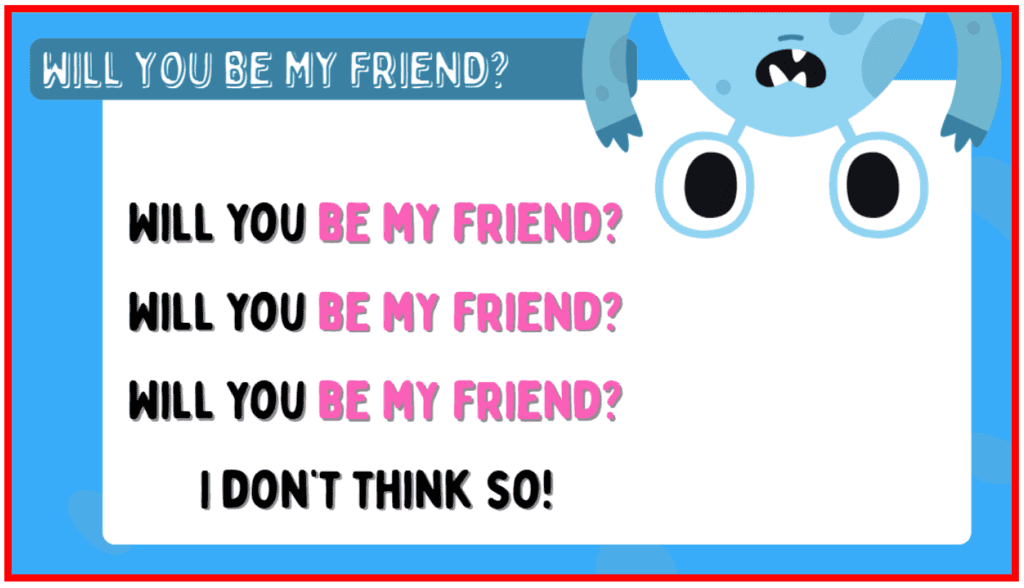
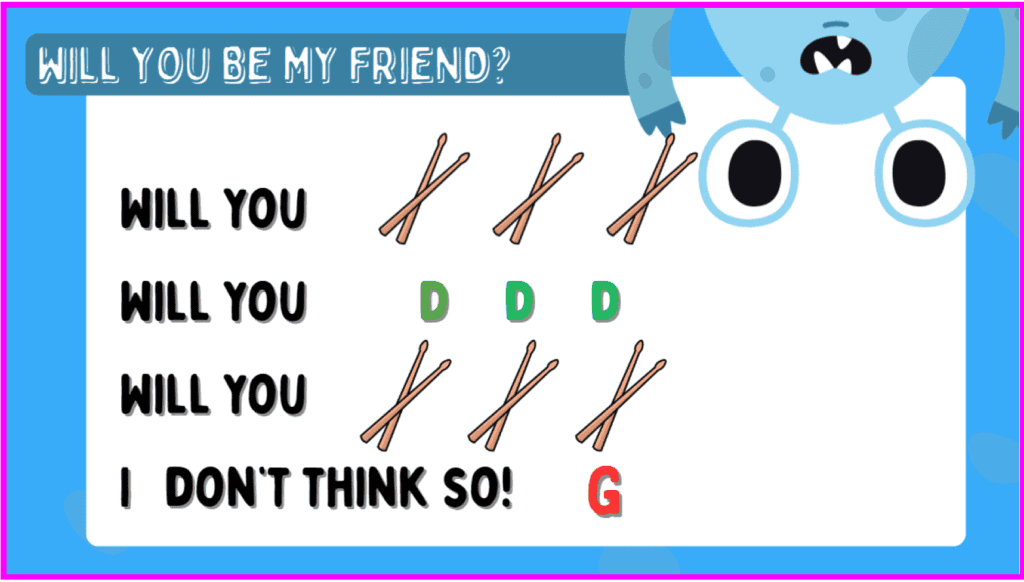
When able, I introduce body percussion. I have the students clap on the pink words.
Step 3:
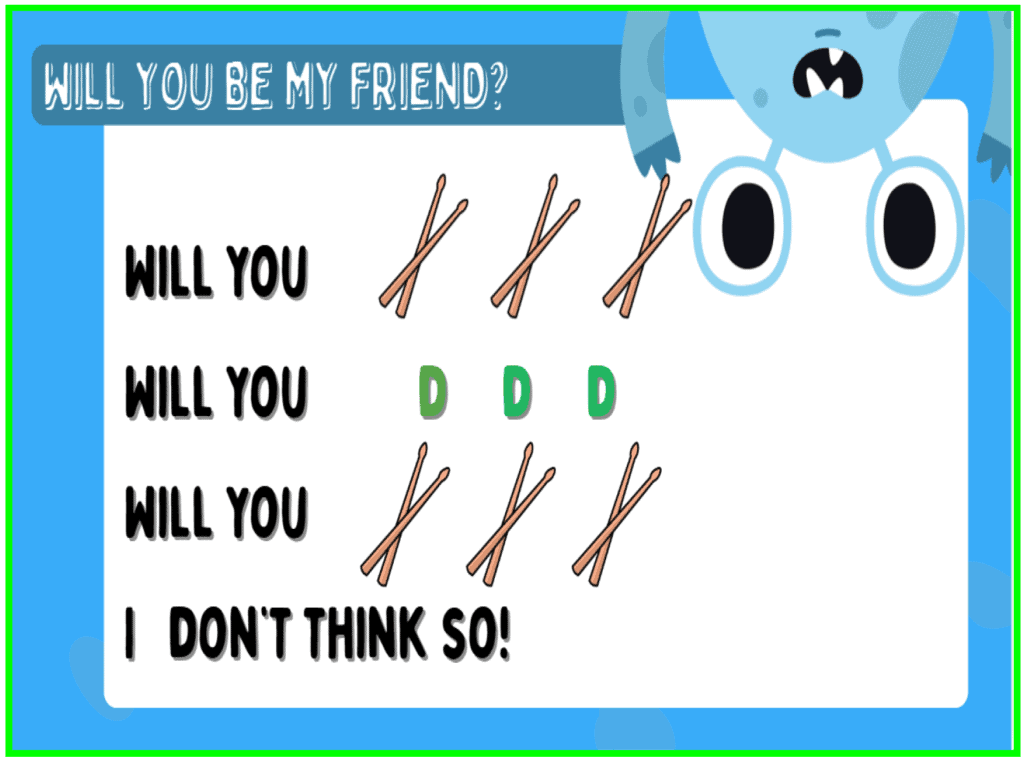
On another day, I introduce part of the melody the students will be playing on the xylophone. Before even going to the xylophones, I switch the clapping on the pink words to, crossing your arms and tapping them together. This preps students to hold space for the “pretend” rests (2 beats). I say “pretend” because eventually it will be part of the melody they play, but not right away!
- We practice crossing and tapping our arms, and then tapping our legs and singing D, D, D, instead of the lyrics, “Be My Friend”
- From there, transfer the melody part to Xylophones.
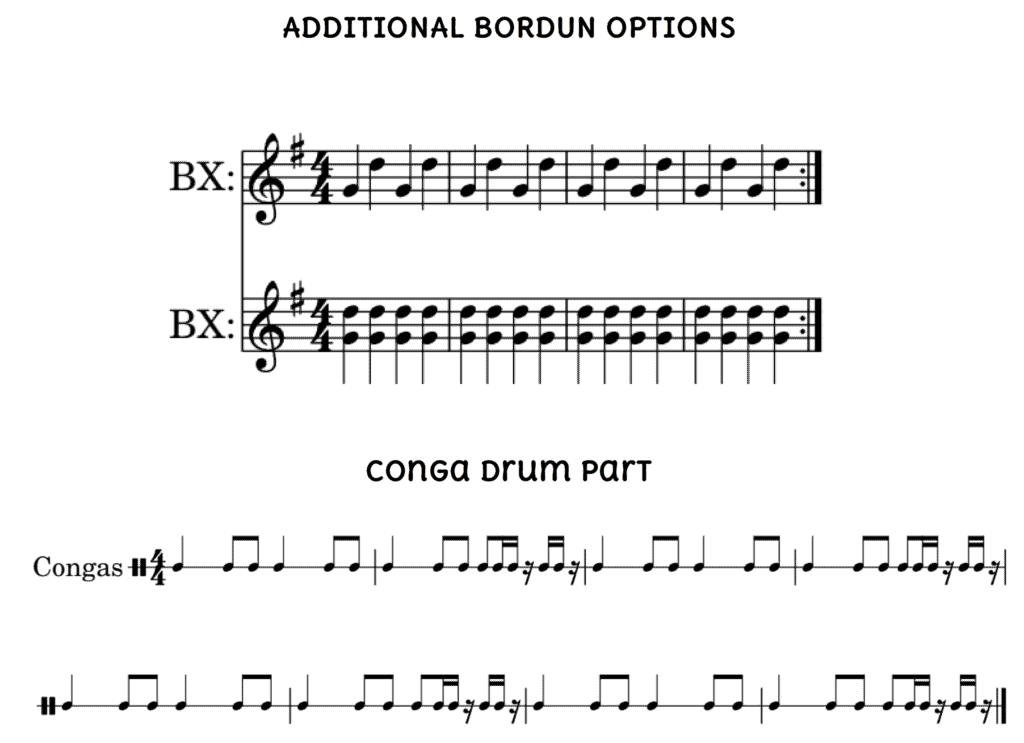
- HELPFUL TIP! Because this melody includes half notes, I play a conga part while students play their xylophones. My conga part keeps the steady beat and holds space for the rests at the end of each measure. When you do this, the students are more able to play their part following the beat. Without this, I find that the students play at different speeds and skip the rests!
Step 4:
On the next slide, I added a G at the end of I don’t think so! I had originally meant this to be my glockenspiel part, but I found that the students really like playing that with the melody!
Step 5:
Continue work on the melody. Suggestions: I always tell students that if they are having trouble playing the whole melody, take some pitches out, only play the pink words, or take out a whole thing. I always encourage them by saying make it work for you! It doesn’t have to be just ONE thing, music has limitless possibilities!
Step 6:
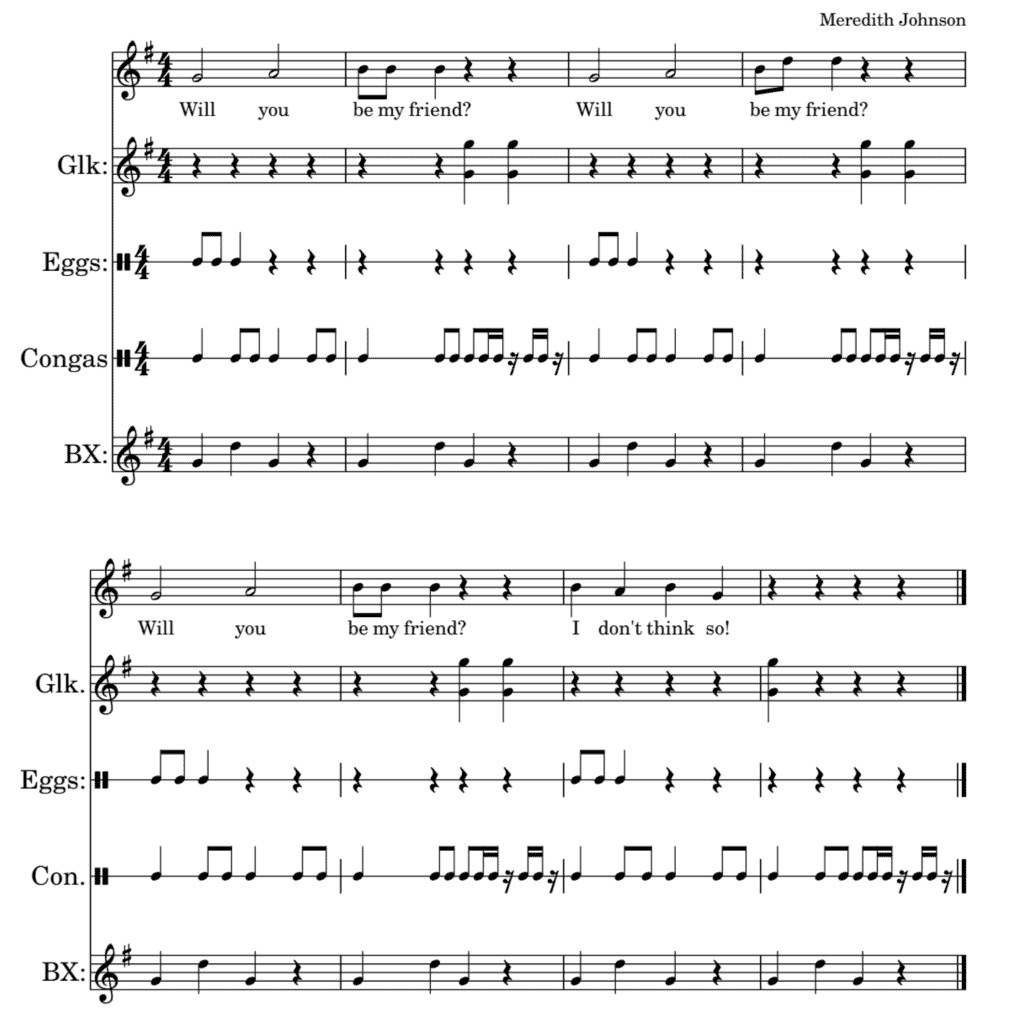
Introduce the Color Part (Glockenspiel) or the bordun part. There are a few ways you can do this:
- On the following pages, I gave three options for your bordun. I tend to have my students practice all of them, and then I let them pick which one they like the best!
- You can of course create your own!
- Playing the conga drum during this practice really helps!
- This is how I teach these parts with my class: the first instrument part I tend to teach is the melody, because the students have already had a ton of practice singing the song, so this part always comes faster to them!
- From there I add the glockenspiel part or the bordun. I tend to decide which one works best as the 2nd option by class. Some classes are stronger in keeping the beat and so in these classes they do the bordun 2nd. Other classes need more practice so they do the glockenspiel part after the melody. The glockenspiel gives additional support to the melody by helping the bordun players stay steady.
WILL YOU BE MY FRIEND?
ORFF ARRANGEMENT
Some students might find it difficult to play the bordun with a rest on the 4th beat. Please see some other options below!
| WHEN STUDENTS ARE READY, PERFORM THE ARRANGEMENT WITH THE BOOK! There are some options in the book where you could add xylo exploration. For example, walk up the xylophone like a quiet, loud, fast, slow monster. Jump on the xylo like a big monster, small monster etc. You can have students echo a rhythm pattern. |
Extensions for This Lesson:
- Use the recording I made for this song! Set it to repeat over and over and allow students to rotate instruments. I have also attached the recording on the last slide!
- Use a different book to go with this lesson.
- Pick a story about what makes a good friend? Add rhythmic building blocks: there are two options I made for you
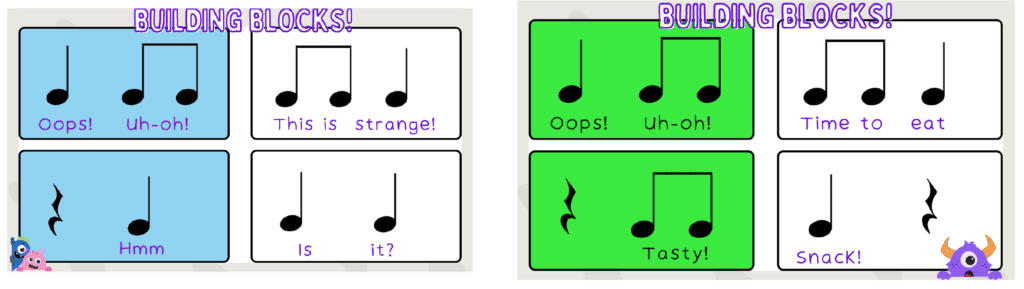
- Create a form- A section is the song and B section are the building blocks
- Add movement: how can we move like a monster? Speed, direction, locomotor, non-locomotor. Work in partners to move like a monster, now in a small group.
- Partner up with a student and one person is the leader, can you mirror your partner?
| I hope this lesson is something that sparks fun in your classroom for your students! But also for YOU! When you are having fun, your students are sure to follow! – Meredith Johnson |









One Response
Meredith – Your lessons are AMAZING! I have completed the 3 Orff Levels, and I thought I’d had a few creative ideas over the years, but then I saw your lessons! I’m blown away by your work. My students love Welcome Back to Music, and I’m excited to order I Just Ate My Friend so I can share this lesson with them as well.
Would you ever consider being a Zoom guest speaker for my General Music Methods class at Ohio University?