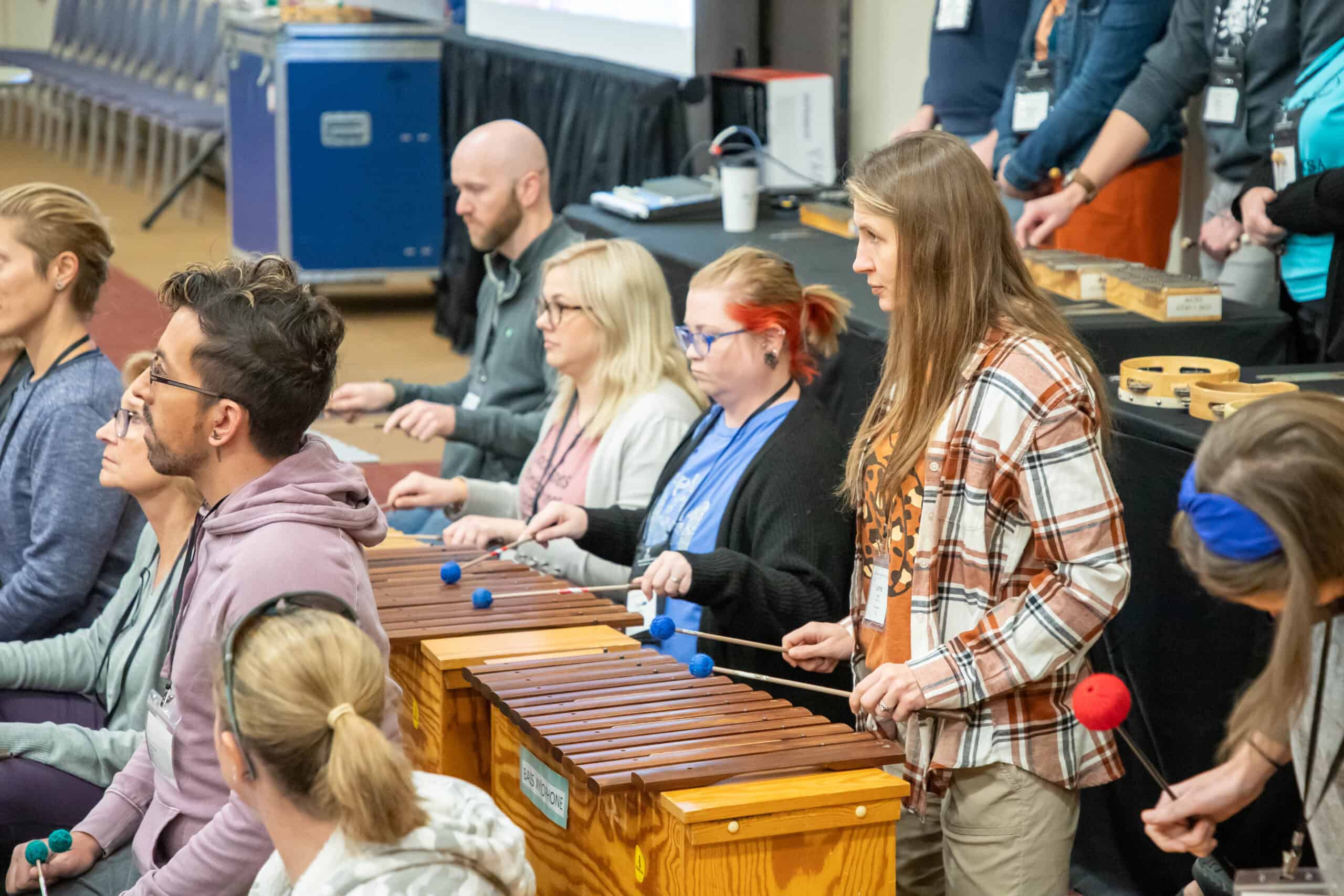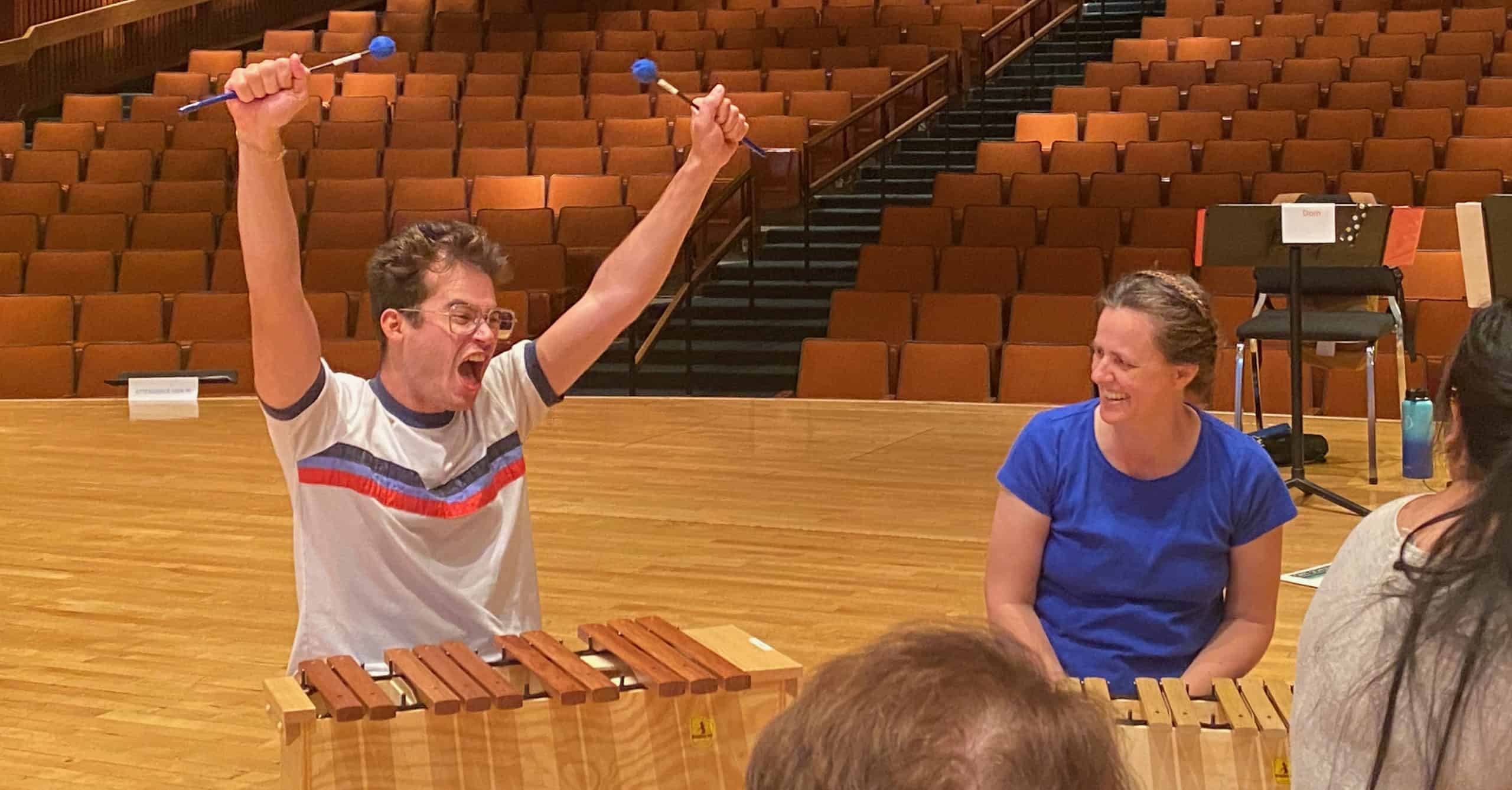
When is a classroom too loud? And whose nervous system gets to decide?
Several years ago, I taught my second graders the singing game Apple Tree for the very first time. If you’ve ever played this game with young children, you know it rarely disappoints. There’s something about the possibility of getting “trapped” by classmates that is absolutely exhilarating to seven-year-olds.
We learned the song, practiced holding hands, reviewed our movement rules, and started playing. It was instant chaos. As soon as the first child was trapped, riotous laughter erupted. By the next round, students were yanking each other’s hands, trying to escape the trap, and singing much too loudly.
Of course, that was the exact moment my principal walked into the room.
To her credit, she immediately jumped in to help. But instead of redirecting the students and continuing the game, I felt pressured to stop the activity altogether. Later that day, she approached me on the playground and commented, “I don’t think they’re ready for that one yet.”
I’ve had years to think about that moment, and one of my conclusions is that my principal and I experienced the exact same classroom situation very differently.
Whose Comfort Zone Are We In?
My principal was an excellent educator who had spent many years in the classroom before becoming an administrator. She ran our school with a strong emphasis on order and consistency. Students were expected to enter and exit assemblies quietly, listen attentively, and maintain a low noise level. When things got loud, she responded quickly.
And then there was me.
I’m an extrovert. I love the energy of children enthusiastically making music. I love when students are laughing, moving, creating, and getting so wrapped up in an activity that they forget to be self-conscious. Does that sometimes tiptoe into silliness? Absolutely. Do I occasionally have to stop, regroup, and remind everyone of our expectations? Of course! But given the choice between a room full of excited, slightly silly children and a room full of disengaged students staring blankly at me, I’ll take the excited ones any day.
My principal and I were both experienced, capable educators, but our preferences and tolerance for different levels of sensory stimulation could not have been more different. Neither preference was inherently wrong. The problem arises when we confuse our own comfort with evidence of student learning.
A quiet classroom is not necessarily a regulated classroom. A noisy classroom is not necessarily a dysregulated one. And compliance is not the same thing as engagement.
Our students experience classroom energy differently, too. Some thrive on the movement, noise, and shared excitement of group music making. Others find that same environment overwhelming or unpredictable. You may see them retreat, cover their ears, or withdraw from an activity altogether. Still others might enjoy a singing game one day and find it overwhelming the next.
A truly inclusive music classroom makes room for all of these learners. That doesn’t mean eliminating loud activities or opportunities for exuberant music making. It means recognizing that participation and engagement can look different for different students, and that the energy level we prefer as teachers may not be what every child needs.
Regulation Is Not the Same as Compliance
Consider The Zones of Regulation, a framework that helps students recognize and understand their emotional and physiological states. In the Blue Zone, students may feel tired, sad, or bored. In the Yellow Zone, they may feel excited, silly, nervous, or have heightened energy. All of the zones are part of being human, and the goal isn’t to remain in the Green Zone all the time. Regulation is about recognizing our internal states and developing tools to support ourselves, not simply controlling behavior.
Personally, I’d often rather redirect a group of giggling, enthusiastic students in the Yellow Zone than try to breathe life into a room full of sleepy, disengaged children. But we have to be careful. An excited student isn’t necessarily engaged in learning, and a quiet student isn’t necessarily disengaged.
A child sitting silently on the edge of a circle might be observing every detail of the activity, processing and participating internally even if they aren’t ready to join physically. Active listening is participation. Meanwhile, another student might be sitting perfectly still, following every direction, and thinking about anything other than music class.
And that wiggly, giggly student? They might be more invested in the lesson than they’ve been in anything all week. Or they might be seeking attention, testing boundaries, or attempting to redirect the activity. Our job is to recognize the difference through observation, relationships, and a willingness to look beyond what behavior appears to mean at first glance.
Conducting the Energy
So how do we harness classroom energy without letting everything descend into chaos or shutting down the joy of music making?
I like to think of it as conducting the energy. Just as a conductor shapes the dynamics, tempo, and character of a musical performance, a teacher can shape the energy of a classroom. Sometimes we need to build excitement, sometimes sustain it, and sometimes bring it back down. Fortunately, Orff-Schulwerk gives us an incredible collection of musical tools to accomplish all three.
Establish expectations before the excitement.
Before redirecting classroom energy, students need to understand what we’re asking them to do. As music teachers, we might teach six classes a day, repeating the same directions until they feel second nature. But the students in front of us may not have attended music class for an entire week! That’s a long time, especially for our youngest learners.
I review four simple expectations at the beginning of every class:
1. Be a First Time Listener. Listen the first time an instruction is given.
2. Stay in Your Bubble. Keep hands, feet, and instruments to yourself unless the activity calls for appropriate interaction.
3. Keep Your Words, Actions, and Expressions Kind. Everything you say, do, and communicate, even with your face, should be kind.
4. Elevate Our Ensemble. Make sure everything you do lifts the whole group up.
When students get too silly, I try to redirect without diminishing their enthusiasm. “I love your creative silly voice! Let’s try that again with our beautiful singing voices so we can all sing together.” Or, “I’m so glad you came to music class ready to laugh! Come join our activity so we can have fun together!”
The message is simple: I’m glad you’re excited to be here. Now let’s use that excitement to make music together.
Match the energy before you try to change it.
Picture a hot afternoon after recess. Students arrive sweaty, loud, and unfocused. You could spend ten minutes insisting that everyone sit quietly, or you could try meeting them where they are.
One of my favorite approaches is inspired by the ISO principle, a concept used in music therapy. The name comes from the Greek isos, meaning equal. The idea is to begin with music that matches a person’s current mood or energy level, then gradually shift toward a desired state. Rather than fighting students’ energy, we acknowledge it, give it somewhere to go, and redirect it. I’ve shared this concept with parents of autistic children who have found it helpful at home, and I’ve found it useful in my classroom.
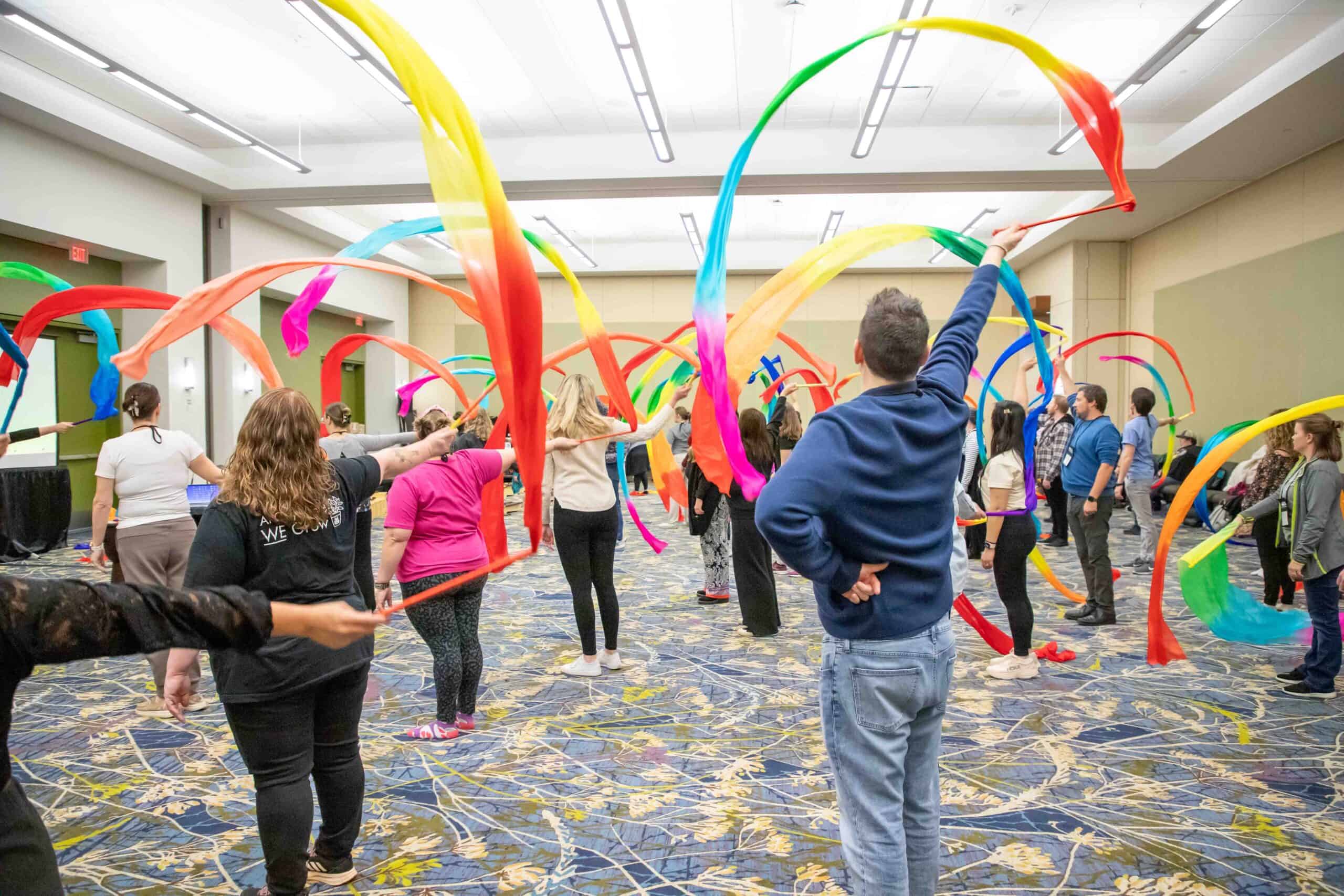
Try this simple movement activity. Have students stand in their personal spaces and mirror your non-locomotor movements to the music. Begin with big, energetic motions and gradually transition toward smaller, smoother movements. After students successfully follow your lead, invite individual students to lead while the class mirrors them. One rule: no extra vocal sounds. This encourages students to focus their energy on movement and observation.
Play approximately 30 seconds of each selection:
1. Sabre Dance by Aram Khachaturian
2. Three Little Birds by Bob Marley and the Wailers
3. Clair de lune by Claude Debussy
The first selection invites energetic movement, the second introduces a relaxed groove, and the third encourages slower, more fluid movement and focused listening. Observe your students and adjust as needed. The goal isn’t to eliminate their energy, but to help them discover how music and movement can influence how they feel.
Sometimes you need to turn the energy up!
Occasionally, the challenge is exactly the opposite. You arrive excited to make music, and your students look ready for a nap. They’re quiet, compliant, and completely disconnected. These are often my most challenging classes!
When that happens, circle mixers can be magical. One of my favorites is Down by the Corner, a Circle Mixer Dance, which I found through physical education teacher Allison Relyea. It’s easy to learn, works particularly well with older students, and gets everyone moving and interacting. If holding hands is a barrier, try having partners cross rhythm sticks instead.
For younger students, a spirited round of If You’re Happy and You Know It or Head, Shoulders, Knees, and Toes may be all it takes to get them singing, laughing, and moving. These aren’t filler activities. They build shared attention, reinforce musical skills, and create the sense of community that makes more complex learning possible.
Make room for students who need less stimulation.
Even with thoughtful planning, not every activity will feel comfortable for every student. Some children need a quieter place to observe, a non-touching adaptation, or a predictable role within an otherwise unpredictable activity.
One of the simplest accommodations I’ve used was a calm-down space. It was just a desk facing the wall, surrounded by a three-sided privacy board. I laminated a breathing activity and taped it to the desk, then added a two-minute sand timer, the kind dentists give children to help them brush their teeth long enough.
I had a student who frequently became overwhelmed during music class. We established a routine: when he needed a break, he simply gave me a peace sign. He could quietly go to the desk, put on hearing-protection earmuffs, turn over the timer, and take two minutes to gather himself before returning to the group. He didn’t need to announce that he was overwhelmed, explain himself to classmates, or interrupt the lesson.
For noise-sensitive students, inexpensive hearing-protection earmuffs can make a meaningful difference. Harbor Freight carries affordable options, and similar products are available elsewhere. A calm-down space doesn’t need to be elaborate. It needs to be predictable, accessible, and supportive.
Most importantly, that student was learning to recognize his own needs and use a tool independently. Isn’t that exactly what we’re trying to teach?
Teachers Have Nervous Systems, Too!
Here’s something we don’t talk about nearly enough: the adults in the room have sensory needs, too.
I have ADHD, and although I love the excitement of active music making, I can also become overstimulated. It’s an interesting contradiction. I thrive on the energy of an enthusiastic classroom, but after hours of singing, talking, listening, moving, and responding to dozens of children, my own nervous system can reach its limit.
One of the most helpful discoveries I’ve made is Flare Calmer, a pair of sound-filtering ear inserts designed to alter how certain frequencies are perceived without significantly reducing overall volume. They’ve been a game changer for me. I can still hear my students clearly, teach, and participate fully, but I don’t feel nearly as overwhelmed by the noise.
I’ve also learned to take sensory breaks during the school day. Sometimes I spend lunch walking around the neighborhood. Other times, I sit quietly in my classroom with nobody talking to me. After a particularly long teaching day, I often drive home in complete silence. No music, no podcast, no phone calls. Just quiet.
For someone who has devoted so much of her life to music, it might seem strange to crave silence. But I’ve learned that these breaks help me recover the energy I need to be present for my students.
We can’t always control the sensory environment of our classrooms, but we can recognize how it affects us. When we acknowledge our own needs, we’re better equipped to recognize and respect the needs of our students.
Looking Back at the Apple Tree
When I remember that second-grade class, I understand why my principal was concerned. The students were pulling on each other, singing too loudly, and moving in ways that had become unsafe. Those things needed attention.
But I don’t think the game itself was the problem.
The students were excited and invested. They wanted desperately to keep playing. What they needed was help managing that excitement while participating successfully. Maybe we needed to stop and practice what happens when someone gets trapped, rehearse safe handholding, or model another round before returning to the full game.
With the benefit of experience, I might have made a different decision that day. I might have said, “Look how excited everyone is! Let’s see if we can use that energy to play safely and make beautiful music together.”
And then we would have tried again.
Recognizing and directing student energy is one of the most complex and interesting parts of teaching. It requires us to be aware of our students’ needs, our own nervous systems, and the demands of the musical task in front of us.
The goal isn’t a classroom that’s always quiet, always excited, or always perfectly controlled. It’s a classroom where students learn to recognize, manage, and use their energy in ways that support themselves and the ensemble.
Music gives us an extraordinary opportunity to teach those skills. Imagine what might happen if children learned early in life that singing can lift their spirits, movement can help release tension, and making music with others can create a sense of belonging. Those are tools they can carry long after they leave our classrooms.
After all, we’re not just teaching children how to make music. We’re helping them discover what music can do for them.
References and Resources
The Zones of Regulation
– Official website
– Teaching The Zones of Regulation with Integrity — On regulation, compliance, and the purpose of the zones
The ISO Principle
– Emotion Modulation through Music after Sadness Induction: The Iso Principle in a Controlled Experimental Study — Peer-reviewed research published in the International Journal of Environmental Research and Public Health (2021)
Classroom Activities
– Down by the Corner: Circle Mixer Dance — Circle mixer associated with PE teacher Allison Relyea
Sensory Supports