
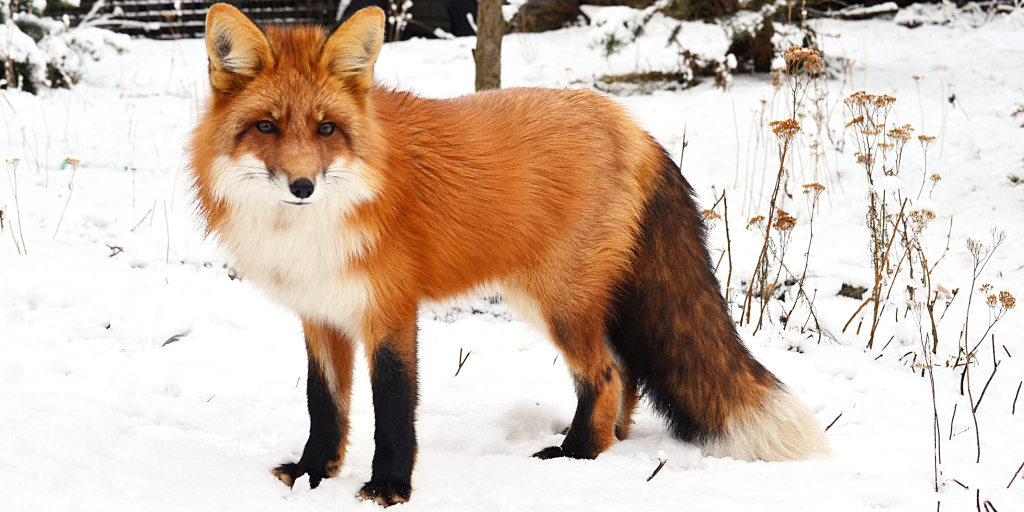

This story and song is an adventure that encourages your students to move, correctly play mallet instruments, and unlock their own musical creativity – all while learning necessary musical skills!
Materials: Canva Presentation, barred instruments, role assignment cards, Movement/Character Cards; Mallet Patterns
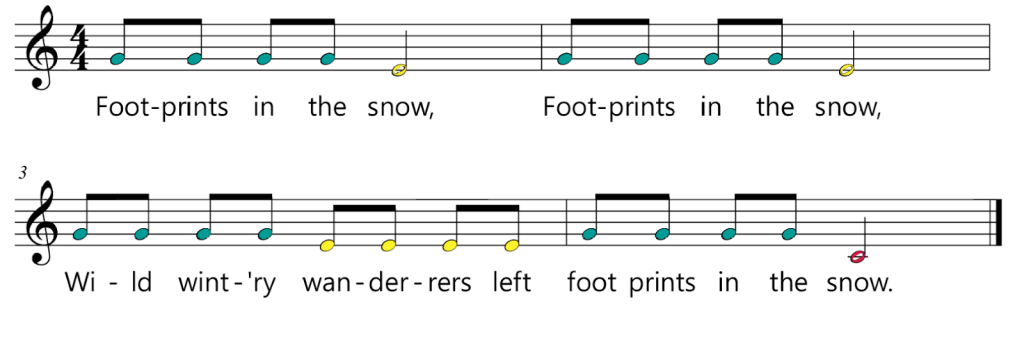
Level: This lesson can be scaled down to kindergarten and up to older elementary if you need a faster, story-based review of mallet technique.
Objective: Students will be able to do the following:
- Express different movement qualities inspired by animal footprints.
- Play mallet instruments with proper technique.
- Improvise movement based on barred instrument performance
- Improvise barred instrument performance based on a dancer’s movement.
- Literacy focus:
- Rhythm: Half notes
- Melody: So-mi-do.
Part 1: Exploring the story through movement.
Material: Bass xylophone for teacher, Canva Presentation
- Teacher: “Have you ever seen animal tracks in the snow? Today we’re going to read a story where we take a look at different animal footprints and experience how those animals move.”
- Before starting, set expectations for student movement. Here are mine:
- As I improvise on the xylophone, students may safely move how I am playing.
- When I begin singing, students should return to their carpet spots.
- When everybody is seated, copy what I am doing on the xylophone with their hands on their laps.
- Students are NOT ALLOWED TO SING. (I’ve found if students start singing along, they miss the final so-do leap.)
- Read through the story, taking time to improvise before singing the melody. You can find the mallet patterns in the Canva presentation under the “Improvisation” menu or on the character cards.
- Rabbit: a plain, vanilla steady-beat drone.
- Bear: a broken drone, starting with the left hand (I turn the xylophone backwards so that when students mirror, they are beginning with their left side.)
- Cat: a double-sticking mallet pattern.
- Fox: an ostinato, with alternating sticking on the eighth notes and two simultaneous mallets on the final quarters. I speak the words “sneak and sneak and sneak and pounce” and have a large melodic leap when I am improvising the pounce.
- Sparrow: an ostinato based on a complementary rhythm. I use two simultaneous mallets to mimic bird hopping.
- Squirrel: I rapid alternate mallets up and down the length of the instrument, randomly stopping.
- Children: I slowly alternate mallets up the instruments, and quickly alternate them down to mimic going up and down a hill to sled.
- At the end of the story, I challenge the students to sing the melody independently and, if time allows, show students the melodic contour and/or solfege where appropriate.
Part 2: Barred Instrument Technique
Materials: Ideally, two students per barred instrument. This lesson can be done with smaller groups of instruments, or more, but this is how I used it in my classroom with first and second grade.
- Review barred instrument procedures for your classroom. I model distribution, removing bars and mallet technique.
- Demonstrate ideal mallet grip and technique while also modeling giving partner feedback. I model making mistakes and getting feedback with the following:
- Grip: a pinched, relaxed grip vs. “giraffe” grip
- Bounce: bouncing the mallet on the bar rather than “sticking the landing.”
- Placement: striking the instrument in the center of the bar rather than too high or too low.
- Divide students into partners and have them go to barred instruments.
- Begin going through the story with the following steps:
- Rabbit: Have students take turns playing a steady beat and giving each other feedback.
- Bear: Have students take turns playing a broken drone and giving each other feedback.
- Cat: Have students take turns playing a double-sticking pattern and giving each other feedback.
- By this point, I have had enough time to circulate and fix mallet hand position where partner feedback has not succeeded. Now I change the format to have partner 1 play while partner 2 moves and vice versa.
- Fox: Mover mimes “sneak and sneak and sneak and POUNCE” while the player plays that rhythm using alternating hands on the barred instruments.
- Sparrow: Mover mimes “Fly – hop, hop, hop,” while the player plays that rhythm using simultaneous hands on the barred instruments.
- Squirrel: This one requires the partners interact – the mover scampers and freezes at random intervals. The player has to start and stop with their mover.
- Children: Player has to copy when their mover is traveling uphill and downhill.
Part 3: Creating a Class Performance
Materials: Movement/Character Cards, barred instruments
- Teacher: “Today we are going to turn Wild Wintery Wanderers into a performance. To do this, we’re going to need students to move and students to play instruments.”
- Use the “Improvisation” section of the presentation to discuss how students can select qualities of movement.
- You can use bingo chips, plastic links, or upload the pictures to SeeSaw to have students select the movement qualities that they choose.
- To perform this story, students need to be in seven groups. Each group is responsible for acting out one animal while playing instruments for another animal.
- Have students work tougher to select movement qualities. Meet with each group to have them practice their mallet part under teacher supervision. Students may also add unpitched percussion or speech if they choose – let your students take the lead!
- Read through the story while students act out their portion. Direct students that are not movers/players for that section that they are supposed to sing the melody for the transition and notice interesting choices that their classmates made.
- After each animal, have students provide feedback for their classmates.
- Have students refine their work and perform again to be recorded for their families, for their classroom teacher, or for the next class that’s coming into the room!
- If you record the class performance, you can further student learning by watching the performance in their next class and having students self-assess their own performance.
Want More?
For a deeper dive into winter themed mallet techniques, check out Kate’s webinar, Frosty Fundamentals. She leads participants through two wintery tales to help students become more comfortable with mallet percussion technique and guidelines for improvisation.
You’ll get ready-to-use lessons, interactive stories, and editable Canva files to bring snowy adventures to life. Best of all, you’ll leave with simple, flexible strategies to keep your students engaged, expressive, and making music all season long.





7 Responses
Love this lesson of Wild Wintery Wanderers! Is there a story or book that goes along with it?
Thank you
Hi Carol! We are delighted you enjoyed the lesson. If you click on the “Canva Presentation” hyperlink in her materials list you’ll find Kate’s story and other helpful materials.
It is included in the CANVA presentation under “Exploring the Story”
I love these lessons. They are so well put together and I am sure my students will love them as well. Is is possible to make the Canva presentation downloadable? My school internet is hideous and tends to go out at the most inopportune moments. Thank you.
The great part about Canva is you can download it as a PowerPoint or PDF or Google Slides!
This is a wonderful resource, full of ideas and possibilities, and I appreciate all the visuals to accompany the activities!
Regarding the downloading question above…
The permissions for the presentation in Canva are not allowing downloads, only the option to copy the link (not the presentation). The other documents (printable) are downloadable, but the presentation is not via the viewing link.
Nevermind…found the link in the presentation to the master Canva file!! Thank you again for a great resource!